




Do Stairlifts Damage Your Stairs or Walls?
Here’s the truth: stairlifts are fitted to your stairs, not your walls, so there’s no drilling into plasterwork or structural work to worry about. It’s one of the most common myths we hear from homeowners, and it puts people off long before they’ve even had a free in-home assessment – worried about damaged walls, weakened staircases, or knocking value off their property. In this guide, we’ll set the record straight, explain exactly how a stairlift is fitted, and cover what happens to your staircase and property value once it’s removed.
Are stairlifts fitted to the wall or the staircase?
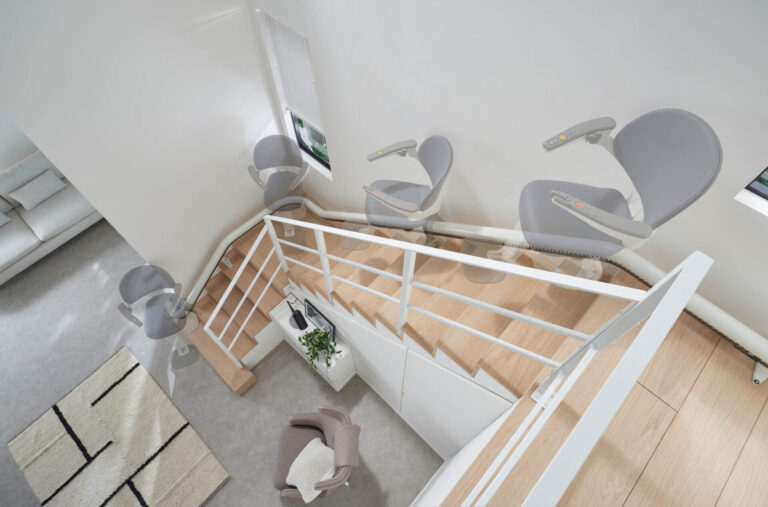
Stairlifts are fitted to the staircase itself, specifically the treads (the flat, horizontal part of each step), not to the wall alongside it. The rail is supported by a small number of legs or brackets, each secured with a few screws driven down into the tread. This is a deliberate engineering choice: stair treads are structural timber or masonry designed to bear weight, whereas the plaster or plasterboard on a stairwell wall generally is not.
Because nothing is drilled into the wall, your plasterwork, wallpaper and paintwork are left completely untouched during installation. This also means the rail follows the exact angle and shape of your stairs precisely, which keeps the ride smooth, rather than depending on wall fixings that might not align as accurately with the pitch of the staircase.
Does a stairlift weaken the staircase?
No. The fixings are short screws into the top surface of each tread, only a few per bracket and spaced out along the flight, so they remove a negligible amount of material from timber that is already sized to carry people and furniture. The rail also spreads the load across several treads rather than concentrating it on one, and the combined weight of rail, carriage and passenger sits well within what a domestic staircase is built to take.
Will a stairlift damage my carpet?
No, a stairlift will not damage your carpet in any lasting way, and in most cases the fixing points are barely visible once the rail is in place. The screws that hold each bracket pass directly through the carpet pile and into the tread underneath, so there’s no need to lift, cut or refit any flooring during installation. Because the screw heads are small and sit flush with the bracket base, most homeowners are surprised at how little visual change there is.
If the stairlift is later removed, the carpet may show slight compression marks where the bracket feet have been sitting, similar to the indentations left by a heavy piece of furniture – as seen in the below ‘before and after’ example images. These generally lift back up with light brushing or vacuuming over a short period, and the screw holes themselves are typically too small to notice once the pile settles back into place.
Before and after: what a removed rail actually leaves behind
Before removal

After removal

Can a stairlift be removed without a trace?
In most cases, yes, a stairlift can be removed with only minor, easily repaired marks rather than any visible trace of long-term damage. Some curved stairlift rails may have fixings on the landing floors, for example if they have a horizontal overrun start or finish – the same applies to these areas, with minimal screw holes.
On carpeted stairs, removal typically leaves small screw holes hidden within the pile and any flattened patches that recover naturally over time. On exposed wood, tile or stone treads, the screw holes are more likely to be visible, but they are small (generally a few millimetres across) and sit only in the surface layer of the material; a professional can fill and colour-match wood with filler and stain or fill stone and tile fixing points with matching grout, so the repair blends in rather than standing out.
Do stairlifts work on wooden stairs?
Absolutely, stairlifts work perfectly well on wooden stairs, and timber treads are actually one of the most straightforward surfaces to fit a rail to. Standard wood screws driven into solid timber treads create a strong, stable fixing, and because the wood is a dense, structural material, it holds the fixings securely without any risk of the rail coming loose over time.
The only real difference compared with carpeted stairs is cosmetic: screw holes will be visible on bare wood rather than hidden in carpet pile, both during use and if the lift is ever removed. This is easily managed with wood filler and a matching stain or varnish, and many surveyors will discuss finish options with you at the survey stage so any marks are as unobtrusive as possible from the outset.
Does a stairlift affect my home's resale value?
Generally, no; most UK property professionals treat a stairlift as a removable fixture rather than a permanent alteration, so it has little direct effect on a formal valuation. RICS lists fitting a stairlift as a home adaptation, alongside grab rails, walk-in showers and outdoor ramps. In valuation terms a stairlift is generally treated as a removable fixture rather than a permanent alteration to the building, which is why it has little direct effect on a formal valuation.
Where a stairlift can influence a sale is buyer perception rather than valuation. Some buyers, particularly those without a need for accessibility features, may view it as clutter or an inconvenience they’ll need to arrange removing, while other buyers, especially older downsizers or multi-generational households, may see it as a genuine selling point that saves them the cost and hassle of fitting one themselves. Because removal is quick and inexpensive, and leaves only the minor, repairable marks described above, it’s rarely a reason to delay a stairlift purchase out of concern for a future sale.
A worthwhile home adaptation
A stairlift fitted by a competent professional is a low-impact, fully reversible addition to your home rather than a renovation that puts your stairs, walls or resale prospects at risk. The rail sits on the treads, the wall is untouched, and any marks left behind, whether on carpet, wood, tile or stone, are cosmetic and straightforward to repair.
If keeping your options open for a future sale matters to you, it is worth asking your supplier at the outset how removal and any minor repairs would be handled, so you have a clear picture before you go ahead. Kudos Stairlifts is a BHTA member and has completed over 5,000 installations across the south-east of England. We have also removed hundreds of stairlifts over those years, so we can tell you from experience exactly what your stairs are likely to look like afterwards.
FAQs
Does installing a stairlift require any drilling into walls?
No. Stairlifts are fixed to the stair treads using brackets and screws, not to the wall. This means your plaster, wallpaper and paintwork remain completely untouched throughout the installation, and there is no chasing into walls at any stage of the process.
How much does it cost to remove a stairlift?
Kudos Stairlifts charge between £175 and £250 (excluding VAT) for a stairlift removal, depending on whether it’s a straight or curved model and if disposal is required. Straight stairlifts are generally quicker and cheaper to remove than bespoke curved rails.
Will a stairlift leave holes in my wooden stairs?
Yes, small screw holes will be visible on bare wooden treads once a stairlift is removed, though these are only a few millimetres wide. A carpenter can typically fill and colour-match these, so they blend in with the surrounding wood, and the structural integrity of the tread isn’t affected.
Should I remove my stairlift before selling my house?
It depends on your likely buyer. In markets with older buyers or downsizers, leaving it in place can be a selling point, while in markets favouring a blank, renovation-ready look, removing it beforehand may help broaden appeal. An estate agent who knows your local market is best placed to advise, and because removal is quick and leaves only minor, repairable marks, this is a decision that can wait until you are close to listing.It depends on your likely buyer. In markets with older buyers or downsizers, leaving it in place can be a selling point, while in markets favouring a blank, renovation-ready look, removing it beforehand may help broaden appeal. An estate agent who knows your local market is best placed to advise, and because removal is quick and leaves only minor, repairable marks, this is a decision that can wait until you are close to listing.
Can a stairlift be moved to a different staircase if I move house?
It is possible, particularly for straight stairlifts, which use a standard rail that can sometimes be refitted elsewhere. A curved rail, however, is custom-built to one specific staircase and usually cannot be reused on a different set of stairs. A survey of your new staircase will confirm whether relocation and reinstallation are genuinely possible.
Contact our Client Focus Team today to discuss how a stairlift can improve and protect the quality of life for you and your family.
Choose from a range of industry-leading curved or straight stairlifts, suitable for almost any staircase and expertly installed by our own engineers.
Call us now on 0800 1522400 to arrange your free, no obligation home assessment and quote, or to ask any questions you may have.