



Choosing a Stairlift After a Hip or Knee Replacement
A stairlift can be a sensible short-term aid after a hip or knee replacement, provided it is set up to suit your surgeon’s or physiotherapist’s guidance on safe movement while you heal. For many people, the first few weeks after joint surgery are the hardest part of recovery: stairs feel daunting, bending is restricted, and fatigue sets in quickly. A stairlift removes the physical strain of climbing steps, letting you rest your new joint while you regain strength and confidence. This guide looks at when stairs typically become manageable again, what to consider before choosing a lift, and why renting can be a more practical option for a recovery period.
Is a stairlift a good idea after a hip replacement?
A stairlift can be a good idea after a hip replacement because it reduces the load on your new joint during the weeks when bending, twisting, and repeated stair use are all restricted. Many patients are given precautions, such as not bending the operated hip past 90 degrees and taking extra care on stairs, for around six weeks or longer, although the exact advice varies by hospital and type of surgery. A stairlift lets you move between floors sitting down, rather than repeatedly flexing and loading a hip that is still healing.
That said, a stairlift may not be suitable for everyone. Many people manage stairs safely within days of surgery using a handrail and the technique taught by hospital physiotherapists: leading with the unoperated leg going up and the operated leg going down. A stairlift tends to help most if your home has a long or steep staircase, you live alone, or your recovery is expected to be slower than average.
What about after a knee replacement?
A stairlift can also help after a knee replacement, mainly because bending the knee fully and taking weight through it on stairs is uncomfortable and tiring in the early weeks. NHS guidance notes that recovery from knee surgery is gradual, and twisting, bending down, and reaching up should all be kept to a minimum at first. Unlike hip surgery, there is usually no strict angle restriction, but stiffness, swelling, and reduced muscle strength can make repeated stair climbing genuinely exhausting.
For knee replacement patients, a stairlift is often less about avoiding a specific movement and more about conserving energy and reducing fall risk while balance and confidence recover.
How long after hip or knee surgery can I use stairs?
Most people can use stairs, with a handrail and the correct technique, before they even leave hospital, often within a day or two of surgery. Physiotherapists commonly teach patients to go up leading with the unoperated leg and down leading with the operated leg and any walking aid, continuing this method until they feel steady enough to walk normally, which is usually around the six-week mark. Full, unrestricted stair use, without conscious thought about technique, tends to develop over the following weeks to months, depending on the individual and the type of surgery performed.
These timeframes are general and vary considerably between patients, depending on age, fitness, the surgical approach used, and how the operation went. Always follow the specific timeline given by your own surgical or physiotherapy team rather than a generic guide, since they will have assessed your hip or knee and your home stairs directly.
Should I rent a stairlift for recovery?
Renting a stairlift can be the more sensible choice for post-operative recovery, since your need for it is likely to be temporary rather than permanent. A rental agreement typically includes the professional installation and removal once you no longer need the lift, so you are not left managing equipment you no longer use. It also avoids the larger upfront cost of buying a stairlift outright, which makes more financial sense if you expect to be back on the stairs unaided within several months.
Buying tends to suit people with a longer-term or worsening mobility need, where the stairlift will remain part of the home for years. If your surgeon expects a good recovery and your main concern is simply getting through the first weeks or months safely, it is worth asking a supplier about rental plans for both straight and curved staircases, rather than committing to a full purchase.
What seat height is best after hip surgery?
The best seat height after hip surgery is one that keeps your hips level with or slightly above your knees when seated, in line with the 90-degree bending precaution your care team will have given you. A seat that sits too low will force your hip into a deeper bend than recommended, increasing the risk of discomfort or, in more serious cases, dislocation of a new hip joint. This is the same reasoning behind avoiding low armchairs, sofas, and toilet seats during early recovery.
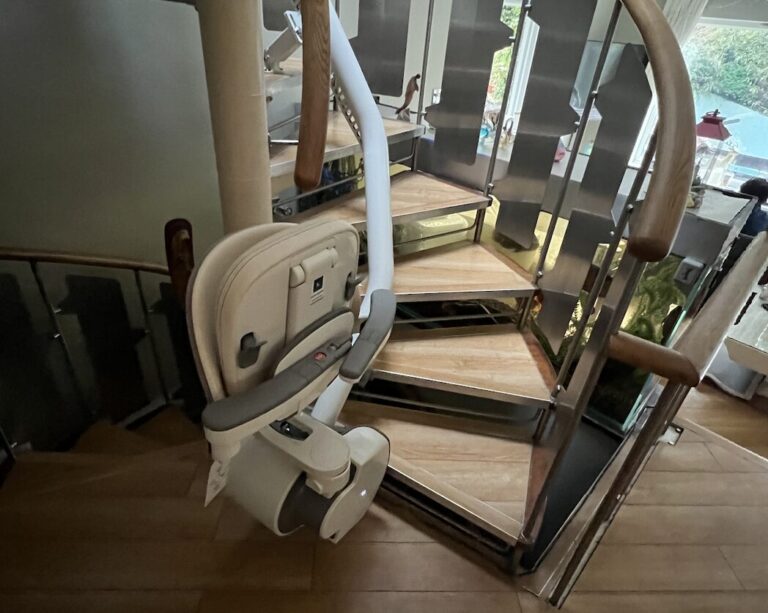
A stairlift seat height that can be adjusted, along with a suitable swivel function at the top of the stairs, is particularly useful here. Swivelling the seat towards the landing lets you stand up facing forward, without twisting your hip or leaning down and across, both of which are movements you are likely to have been told to avoid. Ask your provider whether seat height and swivel angle can be set specifically for your recovery needs when the lift is installed. A good choice for this is the Flow X curved stairlift, which has adjustable seat and footrest heights and a swivel angle that a qualified engineer can set to suit your transfer needs.
What else should I check when choosing a stairlift for recovery?
The most useful features for a short recovery period are a folding seat and footrest, a seatbelt, obstruction sensors, and call and send controls at both ends of the staircase. A folding seat and footrest keep the stairs clear for other household members, which matters if the staircase is narrow or shared. A seatbelt and obstruction sensors add reassurance for you and for anyone helping you on and off the lift in the early days.
If you live with family or a carer, look for a model with call and send controls at both the top and bottom of the stairs. This allows someone else to bring the lift to you, rather than you needing to reach or walk further than advised while your hip or knee is still healing.
Talk to your surgeon or physiotherapist first
Every recovery is different, and the guidance in this article is general rather than tailored to your specific surgery, technique, or home. Before arranging a stairlift, or resuming stair use of any kind, check your individual precautions and timeline with your surgeon, physiotherapist, or occupational therapist. Although the NHS cannot provide you with a stairlift, they can confirm whether a stairlift is appropriate for your circumstances and advise on the safest seat height, technique, and timeframe for your particular joint replacement.
Why Choose Kudos Stairlifts?
- Industry-leading stairlift solutions.
- Customer-focussed service throughout your journey with us.
- Accredited Which? Trusted Trader status held for over 10 years.
- Reputable certifications & accreditations, including BHTA.
- Stannah Accredited Distributor and Access BDD Approved Dealer.
- Trusted by several local authorities to provide stairlifts according to OT specifications
- Expert aftercare and support from our team of highly trained engineers.
Whether you’re looking for a short-term or long-term stairlift solution, we supply & install high-quality stairlifts tailored to your needs. Contact us today to explore your options and take the first step toward greater independence.
FAQs
Do I need a stairlift after every hip or knee replacement?
No. Many people manage stairs safely within days of surgery, so a stairlift is not essential for everyone. Your surgical or physiotherapy team can advise whether one is worth considering for your home and your recovery.
Is it cheaper to rent or buy a stairlift for recovery?
Renting is usually cheaper for short-term needs, since it avoids the full purchase cost and includes installation, servicing, and removal within the rental period. Buying tends to work out better value only if you expect to need the stairlift for a long time, such as with a permanent or progressive mobility condition.
Can a stairlift be installed quickly after surgery?
Yes, it can often be arranged quickly, although timing depends on your staircase and whether the rail needs to be made to measure. Our guide to how long stairlift installation takes explains typical lead times. If you already know a stairlift is likely to help during your recovery, it is worth contacting us on 0203 326 5841 before your surgery date.
What is a swivel seat and why does it matter after hip surgery?
A swivel seat rotates at the top of the stairs so you can step off facing the landing. After hip surgery this avoids twisting the hip and leaning across to get out of the lift. Ask your installer whether the swivel angle can be set to suit your own precautions.
Will a stairlift work on a curved or narrow staircase?
Yes, curved stairlifts are designed to follow bends, turns, and landings, while slimline models are available for narrower staircases with limited space. A home assessment will confirm which type suits your stairs and confirm whether a folding seat and footrest are needed, whether you are renting or buying.
Contact our Client Focus Team today to discuss how a stairlift can improve and protect the quality of life for you and your family.
Choose from a range of industry-leading curved or straight stairlifts, suitable for almost any staircase and expertly installed by our own engineers.
Call us now on 0800 1522400 to arrange your free, no obligation survey and quote, or to ask any questions you may have.