



Stairlifts for Arthritis: The Features That Actually Help
The best stairlift for arthritis is one matched to the joints affected, and usually includes a combination of a powered swivel seat, a powered footrest, an adjustable seat height and simple paddle or rocker controls rather than a stiff toggle switch. For many people with osteoarthritis or rheumatoid arthritis, the staircase becomes one of the first places pain and stiffness show up, often before it affects walking on level ground. This guide walks through exactly which features make the biggest practical difference, why they matter for your joints, and what to check before you choose.
What stairlift is best for someone with arthritis?
The best stairlift for arthritis is the one that matches where your symptoms are worst. If it’s your hands and wrists, controls and seatbelt design matter most; if it’s your hips, knees or lower back, seat height, swivel action and footrest support will make the bigger difference.
Both straight and curved stairlifts can be specified with the same comfort features, including heavy duty models with higher weight limits, so the shape of your staircase doesn’t limit your options. What matters more is having your grip strength, range of movement and pain points properly assessed – ideally by an occupational therapist or a reputable supplier – rather than choosing a model from a brochure alone. Before we get into the details, this list provides a quick overview of the relevant feature choices available across Kudos Stairlifts’ range of models:
- Arm control options: toggle, joystick, rocker, paddle, rudder
- Seat swivel options: powered, automatic, lever-operated, manual
- Footrest folding options: powered, lever-operated, linked to seat, manual
- Seat height options: fixed (from 455mm to 485mm), adjustable (from 380mm to 505mm), perch-style (adjustable from 578mm to 796mm).
Are stairlift controls hard to use with weak grip?
Stairlift controls can be difficult with weak grip, but usually only if you choose a model with a traditional toggle switch – a paddle, rudder or rocker control avoids this problem almost entirely. Toggle switches usually need you to pinch a small lever between your thumb and forefinger and hold it steady, which is exactly the movement that arthritis at the base of the thumb or in the finger joints makes painful.
Paddle controls solve this by replacing the pinch action with a broad, flat lever you can operate with an open palm or the side of your hand – no pinching required. Rocker and rudder controls work similarly: a light press in either direction. Soft-touch joysticks are another alternative, operating similarly to a toggle but requiring a gentle push rather than a full grip. If you’re arranging a demonstration, ask to try the control with the grip you actually have on a difficult day, not your best one.
Toggle

Joystick

Rocker

Paddle

Rudder

Is a powered swivel seat worth it?
A powered swivel seat is worth it for most people with arthritis, because it removes the twisting motion at the top or bottom of the stairs that causes the most joint strain. Getting on and off a stairlift usually means turning your body towards the landing, which puts rotational stress through the hips, knees and lower back – exactly the pattern that flares an arthritic joint.
A manual or lever-operated swivel seat still requires you to lean to one side and rotate the seat yourself, again involving twisting and joint strain. A powered or automatic swivel does that turning for you, usually at the press of a button once you reach the top or bottom, so you step off onto stable, level ground already facing the right direction. It’s a small mechanical detail, but for anyone with hip or knee arthritis it makes getting on and off noticeably steadier.
Do you need a powered footrest if you have painful knees?
A powered footrest is worth having if you have painful knees, because you never have to lift or lower the footrest by hand. It’s one of the more underrated features for people with knee arthritis. A manual or lever-operated footrest must be flipped down by hand, or with a lever to the side of the seat, before you sit, and lifted again once you’ve transferred off, using a bending and pushing motion through the knee and ankle.
A powered footrest lowers and raises at the touch of a control, and a footrest linked to the seat folds with it, so a painful knee is never asked to move a mechanical part under load. This is particularly useful if your symptoms vary day to day, since it means you’re never caught out by a footrest that feels heavier or stiffer than expected.
Does seat height matter if your hips or knees are affected?
Seat height matters a great deal, because sitting down onto a seat that’s too low, or standing back up from one, is one of the most joint-demanding movements on the whole stairlift journey. The lower a seat, the more your knee and hip joints have to bend and then push you back up – precisely the deep-flexion movement that arthritic joints tend to resist most.
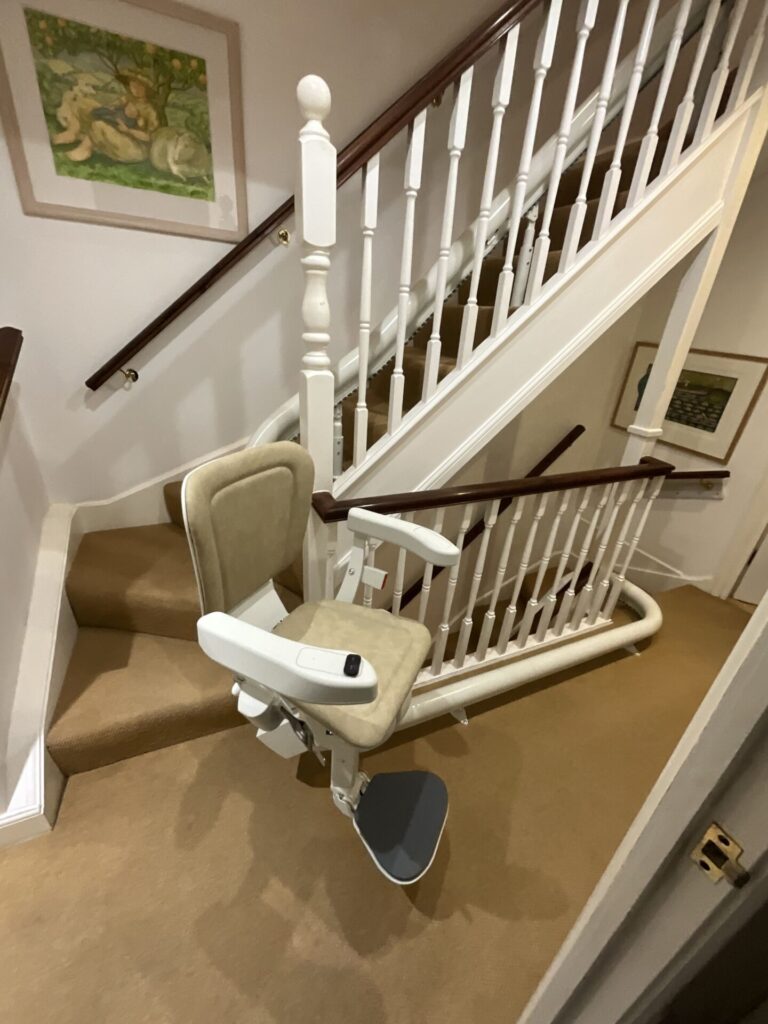
Most stairlifts allow the seat height to be set during installation, and some offer a small range of adjustment afterwards. The Flow X curved stairlift, for example, has adjustable seat and footrest heights, so the fit can be changed if your needs change. It’s worth having this matched to a chair height you already find comfortable elsewhere in your home, so getting on and off feels like a familiar movement rather than a new one to learn.
Finding the right solution for you
Every arthritic joint behaves a little differently, so the right combination of these features depends on where your symptoms are worst – hands, hips, knees, or a mix of all three. An occupational therapist’s assessment can help match features to your needs, and in England and Wales, a Disabled Facilities Grant may help towards the cost if you meet the eligibility criteria. Whichever model you choose, ask to try the controls, swivel and footrest yourself, ideally with the grip and movement you have on a difficult day rather than your best.
Kudos Stairlifts have a variety of stairlift models ready for you to try in our stairlift showroom, allowing you to test which arm controls, swivel and footrest features, and seat height will best suit you – under the guidance of one of our qualified assessors. We have supplied and installed over 5,000 stairlifts to suit a range of needs, including being trusted by several local authorities to provide stairlifts according to OT specifications. Kudos Stairlifts is a Which? Trusted Trader, a Stannah Accredited Distributor and an Access BDD Approved Dealer, with more than 15 years of trading behind us. You can contact our Client Focus Team to arrange your free in-home assessment and showroom appointment, ready to make the right decision to protect your long-term mobility.
Frequently Asked Questions
Can I use a stairlift if I have arthritis in my hands?
Yes. Choose a model with paddle or rocker controls instead of a toggle switch, as these don’t need a firm pinch grip to operate. Also check the seatbelt: a magnetic or push-clip fastening is far easier to manage with sore or stiff fingers than a standard buckle.
Is a stairlift safe for someone with rheumatoid arthritis?
Generally, yes, provided the model suits your current grip strength, balance and range of movement. Because rheumatoid arthritis symptoms can flare and ease over time, it’s worth reviewing your stairlift’s controls and seat features periodically, rather than assuming a model chosen years ago still fits how your joints feel today.
Do stairlifts help with knee osteoarthritis specifically?
Yes, a stairlift can help with knee osteoarthritis, because climbing stairs is often one of the first activities to become painful. A stairlift with a powered footrest and a seat height matched to your usual sitting height removes much of the bending and weight-bearing that stairs demand.
Can I get financial help towards a stairlift if I have arthritis?
You may be eligible for a Disabled Facilities Grant if you live in England or Wales and meet your council’s assessment and means-testing criteria. An occupational therapist’s assessment is usually the first step, and they’ll confirm whether a stairlift is a necessary and appropriate adaptation for your needs.
How do I know which stairlift features I actually need?
Start with where your arthritis affects you most: hands point towards paddle or rocker controls, while hips and knees point towards a powered swivel seat, powered footrest and a well-matched seat height. An occupational therapist or stairlift installer can assess your grip strength, hip and knee flexibility, and balance, then recommend features suited to your specific symptoms rather than a generic, one-size-fits-all model.
Will a stairlift make my arthritis worse?
A stairlift is not a treatment for arthritis and will not change the condition itself. What it does is take the climbing, twisting and bending out of using your stairs. Matching the seat height and swivel to your symptoms matters, because the wrong set-up can still put strain on sore joints. Keeping active in the ways your GP or physiotherapist recommends is still important.
Contact our Client Focus Team today to discuss how a stairlift can improve and protect the quality of life for you and your family.
Choose from a range of industry-leading curved or straight stairlifts, suitable for almost any staircase and expertly installed by our own engineers.
Call us now on 0800 1522400 to arrange your free, no obligation survey and quote, or to ask any questions you may have.