



Will a Stairlift Fit My Stairs? A Simple Measuring Guide
Yes, a stairlift will fit most UK staircases, as long as the narrowest point is at least around 610mm or 24 inches wide; most stairs can usually be accommodated with the right model. If you’re caring for a parent or partner and trying to work out whether a stairlift is even possible before you pick up the phone, this guide will walk you through exactly what to check, how to take the core measurements for your stairlift enquiry yourself, and what to do next.
How do I know if a stairlift will fit my stairs?
You can get a good idea of whether a stairlift will fit by checking three things: the width of your stairs, whether the staircase is straight or curved, and how much clear space there is at the top and bottom. Most straight staircases in UK homes, whether Victorian terraces or modern new builds, are wide enough for a standard stairlift without any structural changes.
Curved, spiral, or very narrow staircases need a bit more thought, but they are very rarely a dealbreaker, since bespoke rails and slimline seats are built specifically for tricky layouts. Even homes with winder steps, half-landings, or doorways close to the stairs can usually be fitted, once the right rail configuration is chosen.
The only way to know for certain is to measure the narrowest section of your stairs and compare it against the minimum widths below. Alternatively, you can skip the measuring altogether and arrange a free survey, where one of our qualified assessors measures everything for you and confirms suitability on the spot.
What is the minimum stair width for a stairlift?
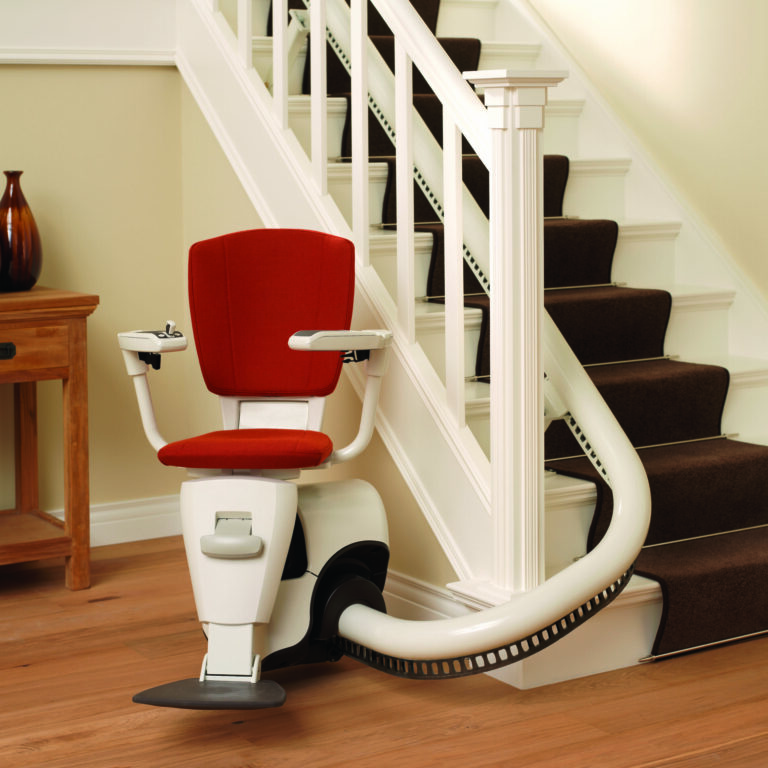
Most standard stairlift models need a stair width of around 700mm (27.5 inches) at the narrowest point, though the user’s height and build also come into play. Specialist slimline models can go narrower – down to around 610mm (24 inches) – so a narrow staircase is rarely a dealbreaker for a stairlift, but it does need confirming by a survey. The Flow X curved stairlift is a good example: its ASL (Advanced Swivel and Levelling) technology lets the seat rotate during travel to negotiate tight spaces safely.
It’s worth remembering that stair width is only one part of the picture. A stairlift installer must also account for the user’s height and build, obstacles such as radiators, windowsills, or handrails, and the space needed for the seat to park safely without blocking a doorway. This is exactly why we always recommend a proper measurement before ordering, whether that’s a first check done by you at home or a full assessment by one of our surveyors during a free visit. Relying on width alone can give a misleading picture, particularly on older or unusually shaped staircases.
How do I measure my staircase?
You can measure key points on your own staircase in around ten minutes using just a tape measure and the checklist provided below. These figures give you a solid starting point to discuss with a stairlift advisor, even though a professional survey will always be the final word before installation. Follow the numbered steps below and refer to the diagram to see exactly where each measurement is taken:
- Measure the width at the narrowest point. Walk up the staircase and identify the tightest spot, often where a handrail, radiator, or wall juts out. Measure wall to wall (or wall to handrail) at that point and note it down in millimetres or inches.
- Count the total number of steps. Count every individual step from the bottom floor to the top floor, including any winder steps on a turn, as this affects rail length and cost.
- Note any curves, turns, or half-landings. Count how many turns are on the staircase, for example a quarter landing or fanned steps, as this helps determine whether you need a straight or curved rail.
- Check the landing space at the top and bottom. Measure the clear floor space where the chair will park, making sure it won’t block a doorway, hallway, or another person’s path.
- Photograph the staircase from top and bottom. Take a few clear photos in good light, including any tight corners or obstacles and the top and bottom landings, to send alongside your measurements.

Do I need to send photos?
Sending photos is not compulsory, but it’s genuinely one of the most useful things you can do to speed up your enquiry if you are simply looking for starting information to determine if you would like to book an home survey. A handful of clear photos, taken from the top and bottom of the stairs and along any bends, lets our team spot potential obstacles before anyone visits your home.
This often means we can give you a much more accurate idea of suitability and likely cost over the phone or by email. It also helps us flag anything unusual, such as low ceilings, tight turns, or narrow doorways, well before a surveyor arrives. That said, photos are never a substitute for professional measurements. Every installation is confirmed by an in-person survey first, since a photo or video call can’t always show wall condition, precise angles, or hidden obstructions accurately.
What else could affect whether a stairlift fits?
Beyond width and shape, a handful of practical details can affect fit and should be checked before you commit to a model. Doorways near the top or bottom of the stairs may need a hinged or folding rail track so they can still open fully once the lift is installed.
Very steep or unusually shaped staircases, including those with winder steps or dog-leg turns, usually need a bespoke curved rail rather than an off-the-shelf straight one. This is common in older terraced houses and cottages, where the stairs were rarely built with straight, uninterrupted runs.
The user’s own height, weight, and mobility also matter, since a taller or larger person may need a wider seat or additional legroom than the bare minimum stair width suggests. A survey takes all of this into account, not just the raw measurements of the staircase itself.
Book your free home survey with Kudos Stairlifts
The most reliable way to find out whether a stairlift will fit your stairs is to book a free, no obligation home survey (sometimes called a home assessment) with Kudos Stairlifts. One of our experienced surveyors will measure your staircase precisely and talk through straight, curved, or slimline options suited to your home.
You’ll receive an accurate, honest quote on the spot, with absolutely no pressure to buy – rest assured that we adhere to BHTA member guidelines. If you’d rather do a first check yourself, use the measuring steps above and send us your figures and photos, and we’ll let you know which models are likely to suit your stairs before we even arrange a visit.
FAQs
Can a stairlift be fitted on a curved staircase?
Yes, curved stairlifts are custom-built for staircases with bends, turns, or half-landings. The rail is manufactured to match the exact shape of your stairs, so almost any curved staircase can accommodate a stairlift, though it typically costs more than a straight model and takes slightly longer to manufacture and install.
How narrow can a staircase be for a stairlift?
It depends on the model. Some slimline models are designed for tight spaces, but the right fit depends on more than width alone – your height, weight, and how the seat needs to park at each end all play a part. That’s why we’d always recommend a quick chat with our team before ruling anything out.
Will a stairlift block my staircase for other people?
No, when properly specified, a folded stairlift seat, arms, and footrest sit neatly against the wall side of the stair, leaving the rest of the tread clear for others to use. Hinged rail sections are also available near doorways, so the track doesn’t obstruct access when not in use.
Do I need planning permission to install a stairlift?
No, stairlifts are generally classed as an internal fixture rather than a structural alteration, so planning permission isn’t normally required in the UK. If you live in a listed building or shared leasehold property, it’s worth checking with your local authority or freeholder as an extra precaution.
How long does a stairlift survey take?
A typical home survey takes around 45 minutes to an hour, during which a surveyor measures your staircase, discusses the user’s needs, and answers any questions. You’ll usually receive a firm, no-obligation quote before the surveyor leaves, with no pressure to decide on the day.
Can I get a stairlift quote without a home visit?
Yes, sending clear photos, a video, and your own measurements can often give us enough information for an initial estimate. A final, guaranteed quote and confirmed model choice will still need an in-person survey to check details a photo can’t capture, such as user ability or exact obstacle positions.
Contact our Client Focus Team today to discuss how a stairlift can improve and protect the quality of life for you and your family.
Choose from a range of industry-leading curved or straight stairlifts, suitable for almost any staircase and expertly installed by our own engineers.
Call us now on 0800 1522400 to arrange your free, no obligation survey and quote, or to ask any questions you may have.